Disclaimer: This article is intended solely for informational and educational purposes only. It does not constitute medical advice.
Nausea and vomiting is one of the most common complications of anesthesia and an important indicator of patient condition and clinical success. In adults undergoing general anesthesia, incidence ranges from 30% to 80% depending on baseline risk (Zhao et al., 2025). The causes of anesthesia-induced nausea and vomiting are multifactorial and arise from the interaction of patient characteristics, surgical stimuli, and the pharmacology of the anesthetic agents.
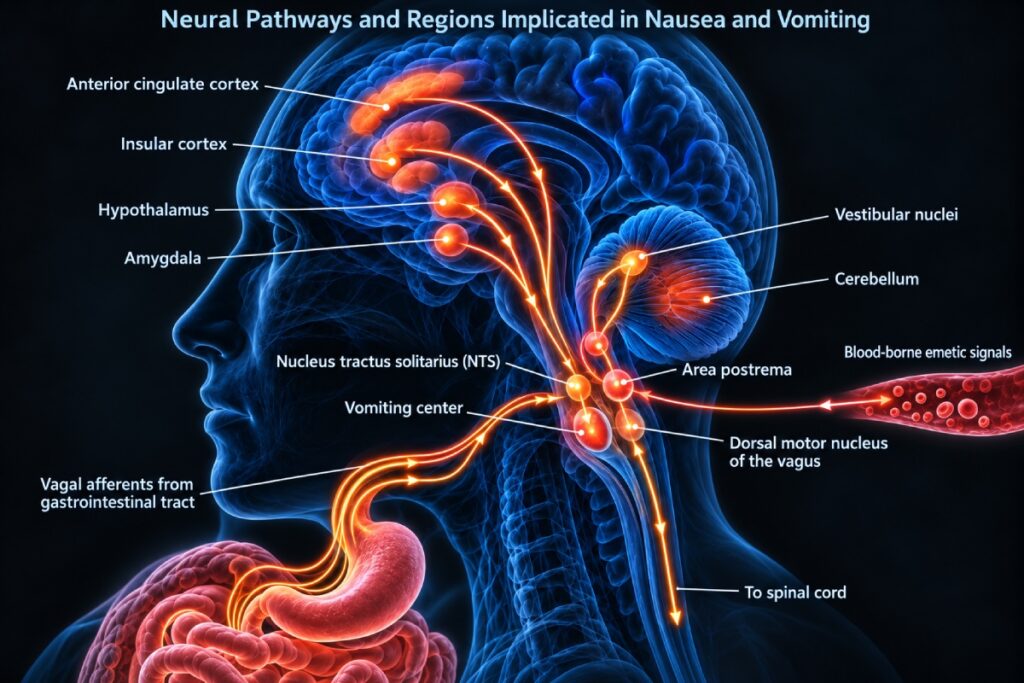
Emesis is coordinated by the dorsal vagal complex of the brainstem, which comprises the area postrema, the nucleus of the solitary tract, and the dorsal motor nucleus of the vagus. The area postrema and nucleus of the solitary tract lack an effective blood-brain barrier and respond rapidly to circulating emetogens (Zhong et al., 2021). Dopamine, serotonin (5-HT3), neurokinin-1, opioid, muscarinic, and histamine receptors mediate these signals.
Peripherally, stimuli trigger enterochromaffin cells to release serotonin and substance P, which activate vagal afferents (Zhong et al., 2021). One study examined 3,223 surgical patients and found postoperative nausea and vomiting (PONV) in 11.9% of those undergoing vagus nerve trunk resection versus 28.7% of those without it (OR 0.302) (Li et al., 2021). This suggests that gut-vagus-brain signaling contributes predominantly to PONV, although the study’s retrospective design limits this conclusion.
Opioids are among the best-established anesthetic causes. They stimulate the area postrema and nucleus of the solitary tract directly, and they act on gastrointestinal mu receptors to inhibit acetylcholine release. The result is reduced peristalsis, gastric dilation, and delayed emptying (Zhao et al., 2025). The effect is dose-dependent and persists for as long as opioids are used for postoperative analgesia (Shaikh et al., 2016).
Inhalational agents and nitrous oxide are considered the principal drivers of nausea and vomiting early in the postoperative period, particularly within two hours of surgery (Zhao et al., 2025; Shaikh et al., 2016). Volatile agents increase c-Fos expression in the rat area postrema and enhance 5-HT3 receptor function in vitro (Zhao et al., 2025). Nitrous oxide may act through central dopamine and opioid receptors, altered middle ear pressure, and bowel distension (Shaikh et al., 2016; Zhong et al., 2021).
In the cohort of Li et al. (2021), inhaled anesthesia carried an odds ratio of 4.020. Reversal agents also matter. Neostigmine is associated with more PONV than sugammadex in a large outpatient registry (17.2% versus 19.6%) (Zhao et al., 2025). Propofol appears protective, whereas remimazolam and its antagonist flumazenil have been linked to higher rates (Zhao et al., 2025). Ketamine has traditionally been implicated, but recent meta-analytic evidence indicates it does not increase risk (Zhao et al., 2025).
Regional anesthesia is not exempt, although general anesthesia carries roughly nine times the risk (Zhao et al., 2025; Shaikh et al., 2016). Neuraxial hypotension may provoke brainstem ischemia or gut ischemia with serotonin release, and sympathetic blockade leaves vagal activity unopposed (Borgeat et al., 2003). Intrathecal morphine can ascend rostrally to the chemoreceptor trigger zone, with nausea peaking at five to six hours. Meperidine, neostigmine, and epinephrine are also associated with increased emesis, whereas lipophilic opioids and clonidine carry lower risk (Borgeat et al., 2003).
Patient and surgical factors modulate these effects. Female sex, non-smoking status, prior PONV or motion sickness, and younger age are the most consistent predictors, with a rough effect on risk of about 10% to 80% as folded into Apfel score calculations (Zhao et al., 2025; Shaikh et al., 2016). Genetic variation, such as the OPRM1 A118 variant, may add susceptibility (Shaikh et al., 2016). Cholecystectomy, laparoscopic, and gynecological procedures are associated with higher incidence. Risk rises by about 60% for every additional 30 minutes of surgery, likely reflecting release of inflammatory mediators such as substance P, 5-HT, TNF-α, and IL-6 (Zhao et al., 2025).
References
Borgeat, A., Ekatodramis, G., & Schenker, C. A. (2003). Postoperative nausea and vomiting in regional anesthesia: A review. Anesthesiology, 98(2), 530–547. https://doi.org/10.1097/00000542-200302000-00036
Li, N., Liu, L., Sun, M., Wang, R., Jin, W., Liu, C., & Hu, Y. (2021). Predominant role of gut-vagus-brain neuronal pathway in postoperative nausea and vomiting: Evidence from an observational cohort study. BMC Anesthesiology, 21, 234. https://doi.org/10.1186/s12871-021-01449-9
Shaikh, S. I., Nagarekha, D., Hegade, G., & Marutheesh, M. (2016). Postoperative nausea and vomiting: A simple yet complex problem. Anesthesia: Essays and Researches, 10(3), 388–396. https://doi.org/10.4103/0259-1162.179310
Zhao, X., Liao, W., Chen, C., Zheng, Y., Li, L., Chang, Q., Qiu, L., & Shen, J. (2025). Postoperative nausea and vomiting: Translating pathophysiological mechanisms into clinical management. Perioperative Medicine, 14, 140. https://doi.org/10.1186/s13741-025-00626-5
Zhong, W., Shahbaz, O., Teskey, G., Beever, A., Kachour, N., Venketaraman, V., & Darmani, N. A. (2021). Mechanisms of nausea and vomiting: Current knowledge and recent